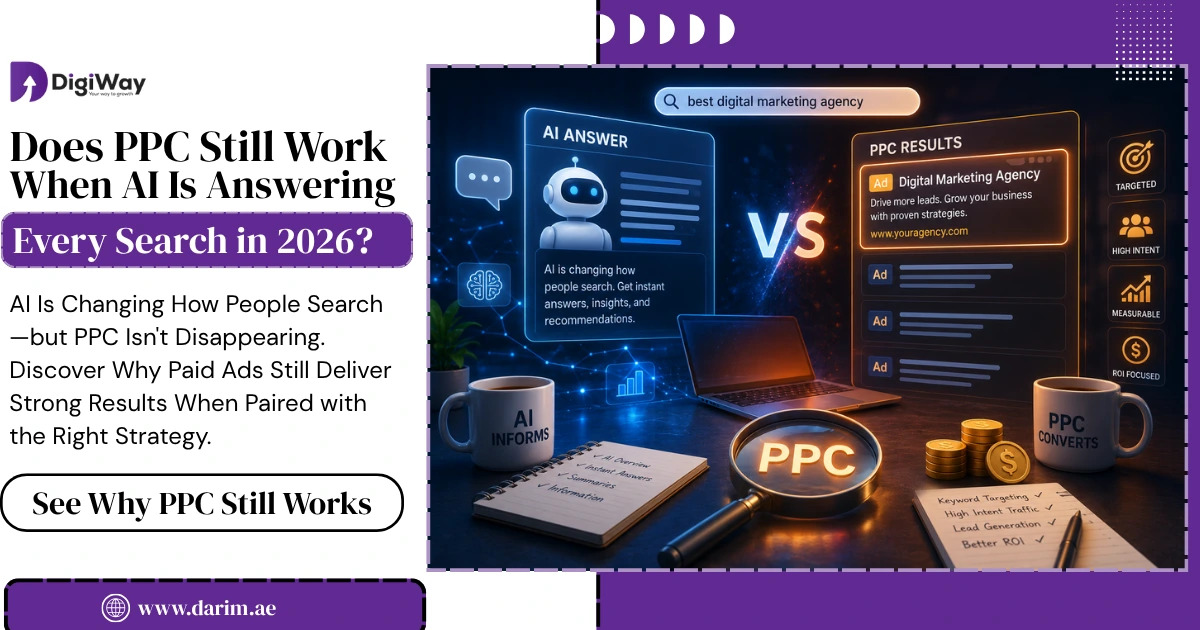
Yes — PPC still works in 2026, but the way it works has fundamentally changed. Google AI Overviews, ChatGPT search, and Perplexity are now answering millions of queries before users ever see an organic result or a paid ad. However, Google Ads, Meta Ads, and other PPC platforms have adapted alongside AI — and businesses that understand this shift are seeing stronger returns than ever. The ones struggling are those running 2022-era campaigns in a 2026 search environment.
How Is AI Search Changing the Way PPC Actually Performs?
AI search is reducing click volume on traditional search results, but it is not killing paid advertising. Google AI Overviews appear above both organic results and, in most cases, above paid search ads for informational queries. This means PPC ads are losing visibility on “what is” and “how does” searches, where users are satisfied by the AI summary.
However, PPC still dominates where it has always been strongest — transactional and commercial intent queries. Searches like “buy running shoes under ₹3000” or “hire a digital marketing agency in India” still trigger paid ads prominently, because AI summaries are less likely to appear for queries with clear purchase intent.
According to a 2025 report by WordStream, paid search ads still generate an average click-through rate of 6–7% on commercial intent queries — showing that PPC performance holds strong where buying decisions are involved.
Does Google AI Overviews Reduce PPC Ad Impressions?
Google AI Overviews reduce ad impressions primarily on informational searches, not commercial ones. Google has confirmed that AI Overviews and Shopping Ads can appear together, and that paid placements within AI-generated responses are actively being tested and rolled out across markets.
In fact, Google introduced AI-powered ad formats directly inside AI Overview responses in late 2024, meaning businesses running Google Ads now have the opportunity to appear inside the AI answer, not just below it. This is a significant shift, and it rewards advertisers who use well-structured landing pages, strong Quality Scores, and relevant ad copy.
The takeaway here is clear: AI search hasn’t removed PPC from the equation, it has moved the goalposts. Businesses that optimize their PPC campaigns for commercial intent and align their landing pages with AI-friendly content will continue to see strong ad performance.
PPC vs SEO vs GEO in 2026 — Which One Actually Drives Results?
All three strategies serve different purposes in 2026, and the smartest businesses are running all three together rather than choosing between them. Here is a direct comparison:
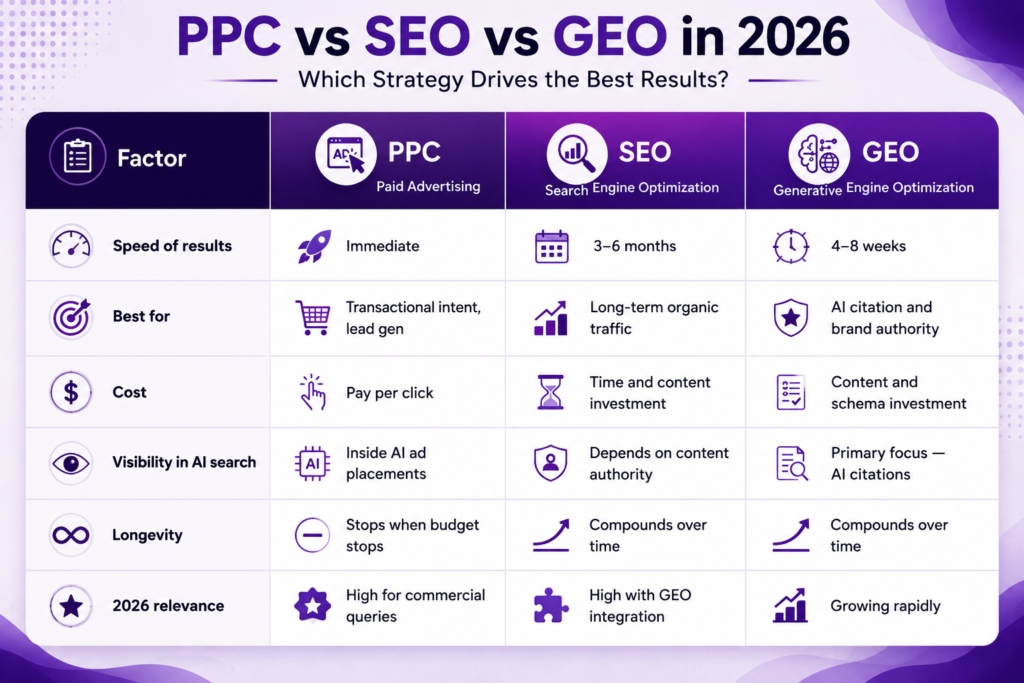
The bottom line: PPC delivers immediate, measurable results on high-intent queries. SEO builds the long-term foundation. GEO extends your visibility into AI-generated answers. A business running only one of these in 2026 is leaving serious growth on the table.
Should You Shift Your PPC Budget to SEO or GEO Instead?
No, shifting your entire PPC budget away from paid advertising in 2026 would be a mistake for most businesses. PPC remains one of the fastest and most controllable ways to drive qualified traffic and leads, particularly for businesses in competitive industries like digital marketing, real estate, healthcare, and e-commerce.
What businesses should do is rebalance — not abandon. Consider this approach:
- Keep PPC running for high-intent, bottom-of-funnel queries where users are ready to buy or enquire.
- Invest in SEO to build the topical authority that supports both organic rankings and GEO citations.
- Add GEO optimization to your content strategy so your brand appears in AI-generated answers for research-phase queries.
At Digiway, the approach is always integrated — because a business that only runs paid ads without building organic authority is one algorithm change away from losing everything. And a business that ignores PPC while waiting for SEO to kick in is losing leads every single day.
How Do You Run PPC Campaigns That Work Alongside AI Search in 2026?
Running PPC effectively in 2026 means adapting your campaigns to the new AI-first search environment. Here is what actually makes a difference right now:
- Focus on commercial and transactional keywords: Avoid bidding heavily on informational keywords where AI summaries are absorbing all the clicks. Shift budget toward queries with clear buying intent.
- Improve your Quality Score aggressively: Google’s AI systems reward ads that lead to genuinely useful, fast-loading, and relevant landing pages. A higher Quality Score means lower cost-per-click and better ad placement, even within AI-integrated results.
- Use audience targeting over keyword targeting alone: In 2026, Google’s AI-powered Smart Bidding and Performance Max campaigns use audience signals more than keyword match types. Feed your campaigns first-party data customer lists, website visitors, CRM data to let Google’s AI find the right users at the right moment.
- Write ad copy that answers questions directly: With AI shaping user expectations for direct, clear answers, your ad headlines and descriptions should mirror that, lead with the benefit, not the feature.
- Test AI-powered ad formats: Google’s responsive search ads, Performance Max, and the emerging AI Overview ad placements all use machine learning to find the best combination of your creative assets. Give the algorithm enough creative variants to work with.
Is PPC Still Worth the Investment for Small and Medium Businesses in 2026?
PPC is absolutely still worth the investment for small and medium businesses in 2026 — provided the campaigns are set up correctly and targeted at the right queries. The mistake many SMBs make is running broad, poorly targeted campaigns and then concluding that PPC doesn’t work.
A well-run PPC campaign for a local or niche business can still deliver a cost-per-lead that significantly outperforms other channels. The key advantages PPC holds for SMBs in 2026 include:
- Immediate visibility: unlike SEO and GEO, paid ads start driving traffic the same day they launch.
- Precise targeting: location, device, time of day, audience segment, and intent signals can all be layered together.
- Measurable ROI: every click, conversion, and rupee spent is trackable, making it one of the most accountable marketing channels available.
- Scalability: start small, test what works, then scale the campaigns that deliver results.
The concern about AI search reducing PPC effectiveness is real but overstated for SMBs targeting local or specific commercial queries. An injury lawyer in Indore, a physiotherapy clinic in Mumbai, or a digital marketing agency in India is not primarily losing leads to AI Overviews, AI summaries tend to dominate broad, national, informational queries, not local, high-intent ones.
Frequently Asked Questions
Q1. Does PPC still work in 2026 with AI search taking over?
Ans: Yes. PPC remains effective in 2026, particularly for commercial and transactional queries where users are ready to buy or enquire. Google AI Overviews primarily absorb clicks on informational searches — paid ads still appear prominently for high-intent queries and are now being tested inside AI-generated responses as well.
Q2. How do Google AI Overviews affect paid ad performance?
Ans: Google AI Overviews reduce both organic and paid click volume for informational queries but have a much smaller impact on commercial-intent searches. Google isn’t sidelining paid ads — it’s embedding them inside AI Overview responses. Advertisers who keep their Quality Scores high and their landing pages sharp are already showing up there.
Q3. Should I stop running PPC ads and invest in SEO instead?
Ans: No. PPC and SEO serve different purposes and work best together. PPC delivers immediate results on high-intent queries while SEO builds long-term organic authority. Cutting PPC entirely while waiting for SEO to produce results means losing leads every day during that gap period.
Q4. What type of keywords still perform well for PPC in 2026?
Ans: Commercial and transactional keywords — phrases where users are ready to take action — still perform strongly for PPC in 2026. Examples include “hire a digital marketing agency,” “best PPC services near me,” or product-specific searches with buying intent. Broad informational keywords are better served by SEO and GEO strategies.
Q5. How can I make my PPC campaigns AI-ready in 2026?
Ans: Focus on first-party audience data, commercial intent keywords, high Quality Scores, and strong landing page relevance. Use Google’s AI-powered bidding strategies like Smart Bidding and Performance Max, and provide enough creative variants for the algorithm to optimize effectively.
Q6. What is the difference between PPC and GEO in digital marketing?
Ans: PPC (Pay-Per-Click) is a paid advertising model where businesses pay for each click on their ads in search results or social platforms. GEO (Generative Engine Optimization) is an organic content strategy that gets your brand cited inside AI-generated answers on platforms like ChatGPT, Perplexity, and Google AI Overviews. Both drive visibility — PPC for immediate paid traffic, GEO for long-term AI citation authority.
PPC Isn’t Dead — But Running It the Old Way Is
The businesses losing faith in PPC in 2026 are usually the ones running outdated campaigns — broad keywords, weak landing pages, no audience signals, and no adaptation to AI search behaviour. The businesses winning with PPC right now are the ones that have updated their approach, integrated it with their SEO and GEO strategy, and leaned into Google’s AI-powered ad tools instead of fighting them.
AI search has changed the landscape, but it hasn’t closed the door on paid advertising. If anything, it has raised the bar — rewarding advertisers who combine smart targeting, quality content, and strategic budget allocation.
If your PPC campaigns aren’t delivering the results you expect, the problem is almost never the channel. It’s the strategy behind it.
At Digiway, we build paid marketing strategies that are designed for the way search actually works in 2026 — not the way it worked three years ago. From Google Ads to Meta Ads to AI-integrated campaign structures, we manage it all with one goal in mind: real growth for your business.
Ready to see what a properly built PPC campaign can do for you?
Book your free strategy call today →