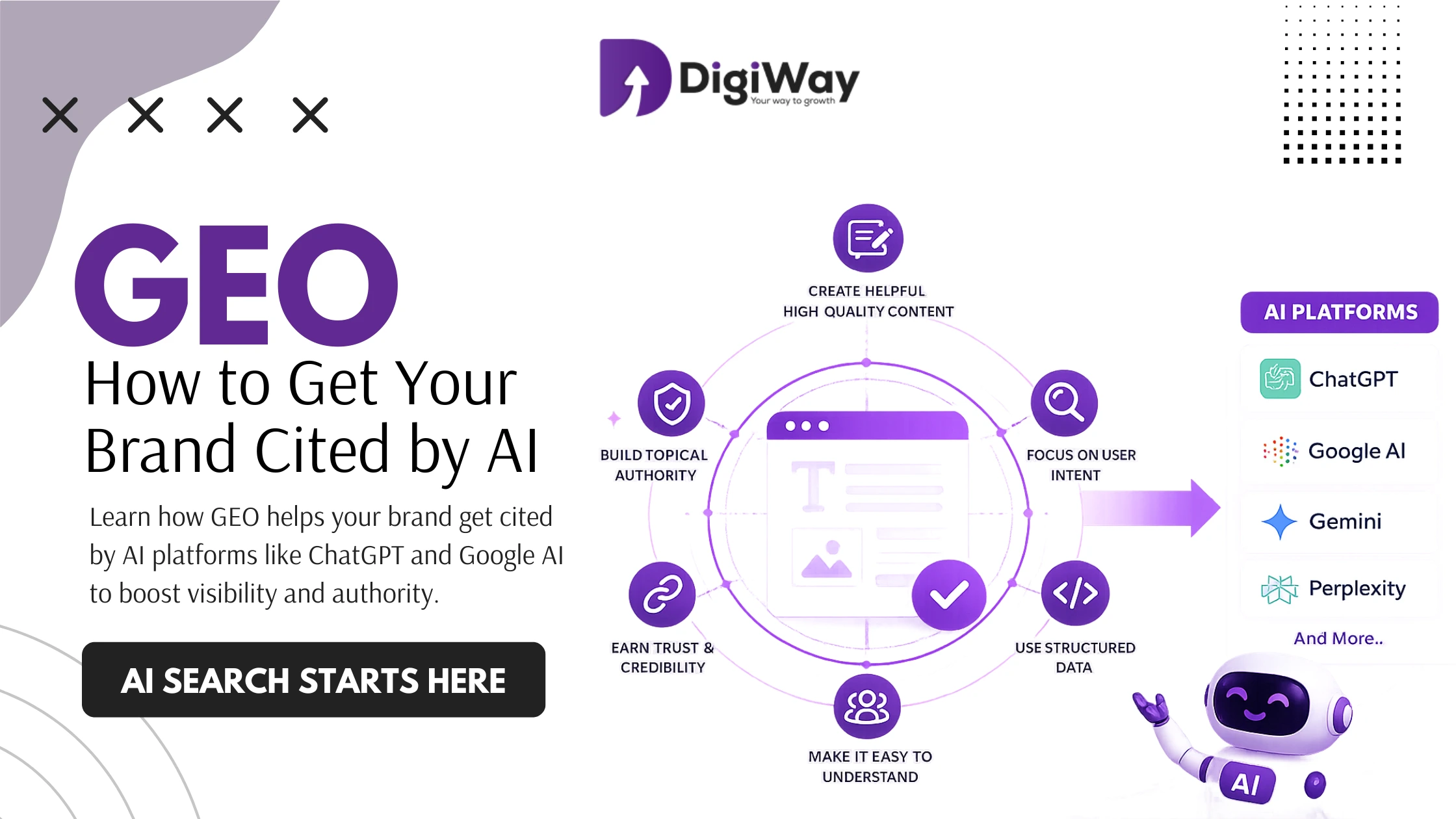
AI Is Answering Your Customers — Is Your Brand Part of That Answer?
Last week, when you looked up something online, what happened? You probably asked a full question and saw an instant reply right away – without opening any links. This shift didn’t come out of nowhere. Tools driven by artificial intelligence – such as Google’s AI summaries, ChatGPT, or Perplexity how people find information, make decisions, and choose brands.
Here is the problem. Most businesses are still optimising for traditional search rankings. They focus on getting to page one of Google. But by the time a user sees those results, they have often already read an AI-generated summary at the top — and moved on.
This is where Generative Engine Optimisation, or GEO, changes everything. GEO is the strategy that gets your brand cited, referenced, and recommended by AI — not just ranked in search. If you want your business to stay visible in 2026 and beyond, GEO is not optional. It is essential.
What Is Generative Engine Optimisation (GEO)?
Generative Engine Optimisation is the practice of making your content visible and citable across AI-powered platforms. These platforms include Google AI Overviews, ChatGPT, Perplexity, Google Gemini, and Microsoft Copilot. Instead of simply ranking on a search results page, GEO focuses on getting AI to use your content as a trusted source when it generates answers.
Here’s an easy way to understand it. Traditional SEO gets you ranked. GEO gets you cited. And in today’s AI-first search environment, being cited carries far more weight than being ranked at position five or six.
Quick answer: Generative Engine Optimisation (GEO) is the process of optimising your website content so that AI platforms like ChatGPT, Google AI Overviews, and Perplexity cite your brand when answering user queries.
Why GEO Matters More Than Ever in 2026
Search behaviour has shifted dramatically. Users are no longer just browsing links. They are asking questions and expecting direct answers. AI platforms read dozens of web pages, summarise the most relevant information, and present it as a single response. The websites that contribute to that response earn visibility, authority, and trust.
Here is why GEO deserves your attention right now:
- AI Overviews appear on millions of searches daily, and they sit above all organic search results.
- When an AI summary appears, click-through rates for standard listings below it drop by up to 42%.
- Brands cited inside AI summaries are seen as experts, which directly increases trust and conversion rates.
- Users who discover a brand through an AI citation tend to arrive more informed and more ready to buy.
- Most businesses have not yet adopted GEO, making this an open opportunity for early movers.
GEO vs SEO vs AEO: Understanding the Difference
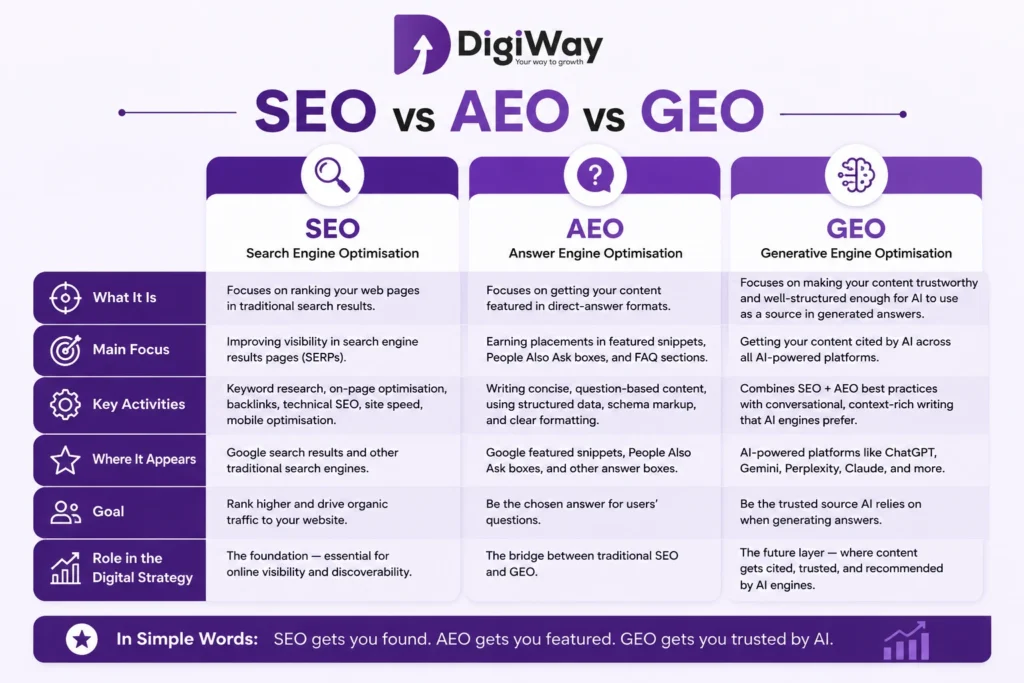
These three strategies are related but distinct. Each one serves a specific purpose in a modern digital marketing plan. Here is how they differ:
SEO — Search Engine Optimisation
SEO focuses on ranking your web pages in traditional search results. It involves keyword research, on-page optimisation, backlinks, and technical performance. SEO is the foundation — and it is still essential. However, it is no longer enough on its own.
AEO — Answer Engine Optimisation
AEO focuses on getting your content featured in direct-answer formats — like Google’s featured snippets, People Also Ask boxes, and FAQ sections. It involves writing concise, question-based content with structured markup. AEO is the bridge between traditional SEO and GEO.
GEO — Generative Engine Optimisation
GEO goes one step further. It focuses on making your content trustworthy and well-structured enough for AI to confidently use as a source when generating answers across all AI-powered platforms. GEO incorporates the best of both SEO and AEO — and adds a layer of conversational, context-rich writing that AI engines prefer.
Remember: You do not have to choose between SEO, AEO, and GEO. The strongest digital strategy in 2026 combines all three. Each one amplifies the others.
How to Optimise Your Content for GEO: 5 Proven Strategies
Getting your brand cited by AI does not require a massive budget or a technical team. It requires a clear, consistent approach to content. Here are five strategies that work.
1. Write Conversational, Context-Rich Content
AI platforms do not just scan for keywords. They look for content that reads naturally, provides context, and answers questions the way a knowledgeable person would. Write the way you speak. Use clear sentences. Explain the ‘why’ and the ‘how’, not just the ‘what’.
Conversational content is the core principle of GEO. When your writing sounds like a genuine expert explaining something clearly, AI is far more likely to pull from it.
2. Use an Answer-First Content Structure
Every section of your blog should start with a direct answer, then expand on it. This makes it easy for AI to extract your key points and use them in a generated summary.
For example, if your heading is ‘What is generative engine optimisation?’, your first sentence should answer that directly. Do not build up to the answer. Lead with it. This is the principle that connects GEO with AEO.
3. Add FAQ Sections with Short, Clear Answers
Frequently asked questions are one of the most powerful formats for AI citation. Structure your FAQs with a question as a heading and a 40 to 60-word answer underneath. Then add FAQ Schema markup so Google’s crawlers can identify these sections instantly.
Every FAQ you write is a potential citation opportunity across Google, ChatGPT, Gemini, and Perplexity simultaneously.
4. Build Topical Authority Through Content Clusters
AI platforms do not just evaluate one page. They assess your website as a whole. If you publish a wide range of deeply connected content on a topic, AI recognises your brand as a trusted authority in that space.
Create a pillar page that covers a broad topic, then write supporting blogs that link back to it. This cluster structure signals expertise — and expertise is exactly what AI engines look for when choosing sources to cite.
5. Strengthen Your E-E-A-T Signals
E-E-A-T stands for Experience, Expertise, Authoritativeness, and Trustworthiness. Google and other AI platforms use these signals to decide whether your content is worth citing. To improve your E-E-A-T:
- Add detailed author bios that include real credentials and experience.
- Share original case studies, data, and insights from your own work.
- Earn backlinks and mentions from respected websites in your industry.
- Display reviews, testimonials, and certifications prominently on your site.
- Update your content regularly so it remains accurate and current.
The higher your E-E-A-T, the more AI trusts your content — and the more frequently it will cite you.
Common GEO Mistakes That Are Costing You Visibility
Many businesses create good content, but still do not appear in AI-generated answers. Here are the most common reasons why — and what to do instead:
- Writing for keywords only: AI does not reward keyword density. It rewards clarity, depth, and genuine helpfulness. Write for people first.
- No FAQ or Q&A sections: Without structured question-and-answer blocks, you miss one of the easiest paths into AI-generated summaries.
- Thin, shallow content: Short posts that skim the surface do not provide enough substance for AI to trust and cite. Go deep on every topic.
- No schema markup: Schema helps AI understand what your content is about. Without it, you are leaving citations to chance.
Frequently Asked Questions
Q1.What is Generative Engine Optimisation (GEO)?
Ans: GEO is the process of optimising your content so AI platforms like ChatGPT, Google AI Overviews, and Perplexity cite your brand when generating answers. It’s built around three things — authority, clarity, and structure — so AI engines can confidently pull from your content as a trusted source.
Q2. How is GEO different from SEO?
Ans: SEO gets you ranked in traditional search results. GEO gets you cited inside AI-generated answers. Both matter, but they work differently. SEO drives clicks from link listings, while GEO earns your brand a mention in AI summaries that appear before users ever see those links.
Q3.Which AI platforms does GEO target?
Ans: GEO works across all major AI-powered platforms — Google AI Overviews, ChatGPT, Perplexity, Google Gemini, and Microsoft Copilot. Essentially, any tool that reads the web and generates answers rather than just listing links is a platform on which your content can be cited.
Q4. Do I need to give up SEO to focus on GEO?
Ans: Not at all. SEO, AEO, and GEO are stronger together than any one alone. SEO builds your foundation, AEO targets direct-answer features, and GEO extends your reach into AI platforms. The smartest strategy runs all three in parallel — they complement each other, not compete.
Q5: How long does GEO take to show results?
Ans: There’s no fixed timeline, but businesses publishing consistent, well-structured content often notice improved AI visibility within a few weeks to a few months. The key variable is topical authority — the more depth you build on a subject over time, the faster and stronger your results become.
Q6. Can smaller businesses benefit from GEO?
Ans: Absolutely. GEO isn’t reserved for big brands with big budgets. Any business producing specific, helpful, well-structured content can earn AI citations. Smaller businesses often have an edge in niche topics — less competition means your content stands out more easily in AI-generated answers.
Conclusion: The Brands AI Recommends Are Winning. Yours Can Too.
Generative Engine Optimisation is not a trend to watch. It is a shift that is already happening. Every day, millions of people get their answers from AI — and the brands that appear in those answers are building trust, authority, and business at a scale that traditional search alone cannot match.
The strategy is clear. Write genuinely helpful, conversational content. Structure it around questions and direct answers. Add schema markup. Build topical depth. Strengthen your E-E-A-T. Do this consistently — and AI will come to your content as a trusted source, again and again.
The window to get ahead is open right now. Most of your competitors have not started. That means the brands that act today will own the AI search landscape tomorrow.
Want AI to recommend your brand? At Digiway, we build SEO, AEO, and GEO strategies that get your business cited by AI and chosen by real customers. From content creation to technical optimisation — we do it all so you can focus on growing your business.
Book Your Free Strategy Call Today! Want more tips on GEO, SEO, and digital growth? Follow us on Instagram for daily insights.