Your Traffic Didn’t Drop. The Game Changed.
Open Google right now. Search anything — “best SEO tips” or “how to grow my business online.” Before you see a single blue link, there’s already a full answer sitting at the top of the page. No scrolling needed. No clicking required.
That is the reality of AI search engines in 2026. And for many businesses, it is the reason their website traffic has quietly been falling for months.
You didn’t get penalized. The entire game just changed overnight. Nobody did anything wrong. The rules of how people search and find businesses online have fundamentally shifted. AI search engines like Google AI Overviews, ChatGPT, Perplexity, and Gemini now answer questions directly, pulling from multiple websites and presenting a single, tidy response to the user.
If your content is one of those sources? You win. If it isn’t? You become invisible to a growing chunk of your audience — even if you’re technically still ranked on page one.
This post breaks down exactly what’s happening, why it matters for your business, and what you should do about it starting today.
What AI Search Engines Are Actually Doing to Website Traffic
Let’s be clear about what’s changed. AI search engines don’t just index your content anymore. They read it, summarise it, and present a combined answer to the user — without necessarily sending them to your website at all.
This behaviour is what experts call zero-click search. The user gets what they need from the AI summary and moves on. No visit, no session, no conversion opportunity — at least not through the traditional click-through route.
Here’s what’s actually happening when you look at the data.
AI Overviews now appear on a significant portion of Google searches every day, sitting above every organic result.
- When an AI summary shows up, the links sitting below it can lose nearly half their usual clicks.
- Meanwhile, brands that get cited inside the AI summary gain visibility and credibility that no paid ad can replicate.
- Traffic in 2026 is moving in two very different directions. Some businesses are losing clicks. Others are gaining a different kind of visibility — one that builds brand trust
faster than a ranking ever could. The difference between the two groups comes down to one thing: how well their content is built for AI search engines.
The Shift Nobody Warned You About: From Ranking to Being Cited
For years, the SEO goal was simple. Rank on page one. Get the click. Convert the visitor. That process still works — but there’s a new step that comes before all of it now.
Before a user even reaches your ranking, an AI search engine may have already answered their question. If AI pulls from your website to answer a question, it shows your brand as the source of that answer. That’s a citation. And citations are the new first impression.
Think of it this way. A ranking puts you in the search results. A citation puts you in the answer. Those are two very different positions — and in 2026, the answer is what users see first.
This is the core shift that businesses need to understand. The goal of SEO hasn’t disappeared. It has expanded. You still need to rank.
But ranking alone won’t cut it anymore — AI needs to trust you before it mentions you.
Why Some Websites Are Thriving in AI Search (And What They’re Doing Differently)
Not every business is struggling with this transition. Some websites are actually seeing more visibility than before — because they accidentally built their content in a way that AI search engines love.
Here’s what those websites have in common:
- They write in clear, direct language. AI doesn’t reward clever writing or keyword density. It rewards clarity. If your content is clear, direct, and actually answers the question — AI is far more likely to use it.
- They structure content around questions. Every heading reads like something a real person would type into a search bar. Each section starts with a straight answer, then builds on it with more detail. This structure makes it easy for AI to extract useful information.
- They cover topics deeply. A 400-word blog that skims the surface doesn’t give AI enough substance to work with. Websites that publish thorough, well-researched content on a single topic signal genuine expertise — and AI search engines treat expertise as trustworthiness.
- They use schema markup. This is the technical side of the equation. Schema markup tells AI exactly what your content is — whether it’s a FAQ, a how-to guide, or an article. Without it, AI has to guess. With it, AI knows immediately that your content is a reliable, structured source.
- They’ve built topical authority. Instead of publishing random blogs, these websites publish interconnected content clusters — a main pillar page on a broad topic, supported by several deeper posts that all link back to it. That’s how AI figures out which website actually knows what it’s talking about on a topic.
How AI Search Engines Decide Which Content to Use
This is the question worth losing sleep over. AI is out there writing answers for your potential customers right now — so what actually makes it pick one website over another?
The honest answer is credibility. AI search engines look at your content through five lenses before deciding whether it’s worth citing:
- Relevance — Does this page get straight to what the user is actually asking, or does it just mention the topic in passing?
- Authority — Has this website built a real reputation in this subject area, or is it a one-off post on a site that covers everything and nothing?
- Structure — Is the content laid out in a way that’s easy to read, scan, and extract — or is it a wall of text with no clear direction?
- Freshness — Does this content reflect how things stand today, or has it been sitting untouched since the last algorithm update?
- E-E-A-T — Does the content show real Experience, Expertise, Authoritativeness, and Trustworthiness — or does it just sound like it does?
Working on all five of these is not just smart SEO. It’s the actual entry ticket to showing up in AI-generated answers — where more and more of your audience is starting their search.
Your SEO Strategy Needs an Upgrade — Here’s Where to Start
Here’s the practical part. If you’re worried about falling website traffic in 2026, the answer is not to panic or to abandon SEO. The answer is to evolve it.
Specifically, three disciplines now work together in a modern search strategy:
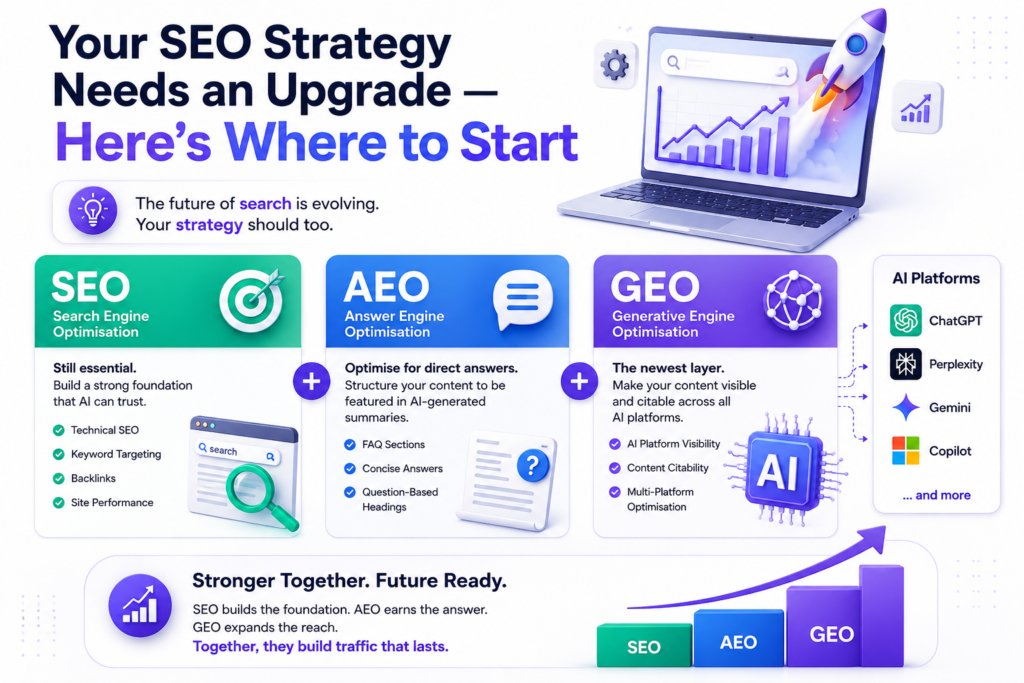
- SEO ( Search Engine Optimisation): Still essential. Your technical foundation, keyword targeting, backlinks, and site performance all feed into how AI evaluates your domain.
- AEO (Answer Engine Optimisation): This is about structuring your content for direct answers. FAQ sections, concise definitions, question-based headings — all of this improves your chances of being cited in AI-generated summaries.
- GEO (Generative Engine Optimisation): The newest layer. GEO focuses specifically on making your content visible and citable across all AI platforms — not just Google, but ChatGPT, Perplexity, Gemini, and Copilot as well.
None of these replace each other. They stack on top of each other. And businesses that implement all three are the ones building traffic that is genuinely resilient — not just to algorithm updates, but to the entire structural shift happening in how people search.
Frequently Asked Questions
Q1. Why is my website traffic dropping in 2026?
Ans: Traffic drops in 2026 are often linked to AI Overviews appearing on search results. When AI answers a query directly, fewer users click through to individual websites. The solution is optimising your content to be cited inside those AI summaries, not just ranked below them.
Q2. What is an AI search engine?
Ans: An AI search engine uses artificial intelligence to understand user queries and generate direct answers, often pulling from multiple web sources. Examples include Google AI Overviews, ChatGPT, Perplexity, and Microsoft Copilot.
Q3. How do I get my website cited in AI search results?
Ans: Write clear, answer-first content structured around real questions. Use FAQ sections with schema markup. Build topical authority through connected content clusters. Strengthen your E-E-A-T signals with author bios, case studies, and consistent publishing.
Q4. Does SEO still work in 2026?
Ans: Yes — but it works differently now. Traditional SEO builds your foundation. AEO and GEO extend your visibility into AI-generated answers. A complete strategy uses all three together.
Conclusion: Adapt Now, Win Later
AI search engines are not a temporary trend. They are the new infrastructure of how people find businesses, make decisions, and choose who to trust. The websites that understand this shift — and build their content strategy around it — will grow. The ones that don’t will keep watching their traffic slide without understanding why.
The good news is that this is fixable. You don’t need to rebuild everything. You need to be intentional about how you create content, how you structure it, and how you signal expertise to the AI platforms that are increasingly shaping your audience’s first impression of your brand.
Start with one blog. Build one FAQ section. Create one content cluster. The compounding effect of good content is real — and it starts the moment you publish.
Your traffic deserves a strategy built for 2026. At Digiway, we help businesses across India and globally adapt to AI search — with SEO, AEO, and GEO strategies that drive real, measurable growth. No guesswork. No shortcuts. Just a plan that works.
Let’s Build Yours! Book Your Free Strategy Call Today! Want more tips on AEO, GEO, SEO, and digital growth? Follow us on Instagram for daily insights.