Google AI Overviews have changed where your content needs to show up — not just how it ranks. Google AI Overviews now appear before organic results on millions of searches every day. Your page-one ranking is still there — it is just no longer the first thing anyone sees. For businesses and marketers who built their entire growth strategy around page-one rankings, that is a genuinely uncomfortable shift. But here is what most people are getting wrong — AI Overviews are not the end of SEO. They are a new layer of it. And the businesses that understand this early are quietly building an advantage that will be very hard to close later.
What Has Google AI Overviews Actually Changed About SEO?
Let’s be direct about this. Google AI Overviews have not killed organic search; they have changed what organic visibility actually means.
Before AI Overviews, ranking on page one meant your blue link was one of the first things a user saw. Now, a significant portion of users read an AI-generated summary, get the gist of what they were looking for, and leave without clicking anything. This is called a zero-click search, and it has been growing steadily for years. AI Overviews have accelerated it considerably on informational queries.
But here is the part that gets missed in most of the doom-and-gloom coverage. Pages that get cited inside Google AI Overviews often see a different kind of traffic benefit — branded searches, direct visits, and higher-intent users who already encountered the brand in an AI summary and came back to learn more. A citation inside an AI Overview is not the same as a click, but it is not worthless either. It is a brand impression at the exact moment someone is actively researching a topic.
The businesses losing ground right now are the ones whose entire SEO strategy was built around informational keyword traffic — top-of-funnel articles designed to capture clicks on broad queries. That model is under real pressure. The businesses holding steady or growing are the ones targeting commercial intent keywords, building genuine topical authority, and structuring content in a way that AI systems can actually extract and cite.
Why Does Google AI Overviews Pick Some Content and Ignore Others?
This is the question every SEO professional is working through right now, and the honest answer is that there is no single confirmed formula. However, patterns have emerged clearly enough to draw some reliable conclusions.
Google AI Overviews consistently pull from content that does a few things well. First, it answers the question immediately — the main point is in the first sentence or two, not buried after three paragraphs of context-setting. Second, the content is structured in a way that makes individual sections extractable on their own. Clear headings, short paragraphs, and bullet points all make it easier for Google’s systems to identify what a piece of content is actually about.
Beyond structure, authority matters enormously. Google AI Overviews draw heavily from websites that Google already trusts — sites with strong backlink profiles, demonstrated topical depth, and content that shows genuine first-hand knowledge rather than surface-level summaries. This is where E-E-A-T comes in. Experience, Expertise, Authoritativeness, and Trustworthiness are the signals Google uses to decide whether a source is worth citing. A website that publishes one strong article on a topic is far less likely to be cited than one that has built deep, interconnected content across an entire subject area.
One more thing worth mentioning — FAQ sections with proper schema markup are consistently among the most cited content formats inside AI Overviews. Structured Q&A content gives Google’s systems exactly what they need: a clear question and a tight, direct answer. If your website does not have FAQ sections on its key pages, that is one of the easiest wins available to you right now.
SEO Before vs After Google AI Overviews
The way SEO works has shifted at a fundamental level. The table below shows exactly where SEO stands today versus where it stood before AI Overviews took over.
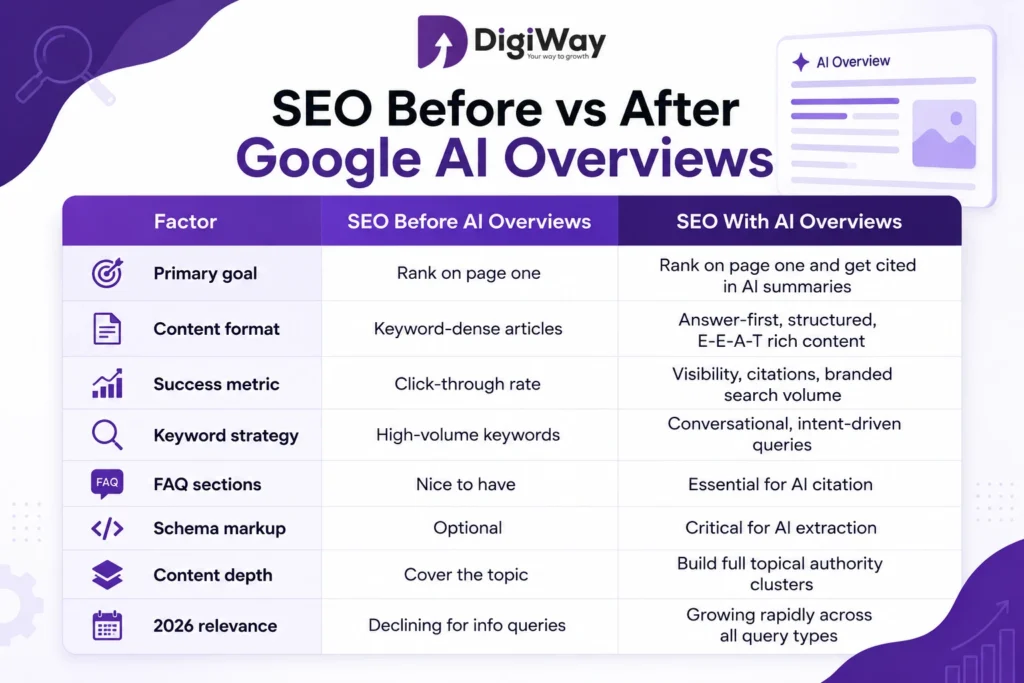
The shift is not about abandoning what worked before. Strong technical SEO, quality backlinks, and well-researched content still matter; they are the foundation everything else is built on. What has changed is the layer on top of that foundation. Content now needs to be structured for extraction, not just for ranking.
What SEO Strategies Actually Work Alongside Google AI Overviews?
Rather than listing ten things to do, here are the four that genuinely move the needle — based on what is working in practice right now, not what sounds good in theory.
- Write for extraction, not just for ranking: Every section of your content should open with a direct, standalone answer to the question your heading asks. Do not build up to your main point; lead with it. Google AI Overviews pull the clearest, most immediate answer available. If your insight is buried in paragraph four, the AI skips past it and cites someone else.
- Build content clusters, not isolated articles: Google AI Overviews do not reward individual articles. They reward websites that have built real, demonstrable depth across an entire topic. Google evaluates your website’s overall authority on a subject. That means creating a pillar page that covers the broad topic, then building out supporting content that links back to it — each piece going deeper on a specific angle. This cluster structure signals genuine expertise in a way that standalone articles simply do not.
- Treat schema markup as non-negotiable: FAQPage schema, HowTo schema, and Article schema are the clearest signals available to Google’s AI systems about what your content covers and how it is structured. Without schema, Google has to figure it out on its own — which means your content is competing at a disadvantage against pages that have made it easy. Adding schema to your key pages takes a relatively small amount of time and has an outsized impact on AI citation likelihood.
- Update your existing content before creating new content: This one gets overlooked constantly. Google AI Overviews prioritize current, accurate sources. An article you published two years ago with outdated statistics and stale examples is actively working against you. A regular content audit — updating facts, refreshing examples, adding new sections — is one of the highest-ROI SEO activities available in 2026.
Is Traditional SEO Still Worth It When AI Overviews Are Taking All the Clicks?
Yes — and this is not a lukewarm yes. Traditional SEO remains one of the most valuable long-term investments a business can make in 2026, for a reason that often gets lost in the AI Overview panic.
Google AI Overviews appear far less frequently on commercial and transactional queries. When someone searches “digital marketing agency in India” or “best SEO services for small business,” they are not looking for an AI summary — they are looking for a provider. These searches still produce traditional organic results, Google Maps listings, and paid ads. A business with strong SEO on commercial intent keywords is largely unaffected by AI Overviews on those queries.
The businesses most exposed to the AI Overview shift are those that built their traffic model entirely around informational keywords — broad how-to content designed to capture top-of-funnel visitors. If that describes your current strategy, the answer is not to abandon SEO. It is to rebalance toward commercial intent content while continuing to produce informational content structured for AI citation rather than just for clicks.
The Mistakes Businesses Are Making Right Now Because of Google AI Overviews
A few patterns keep coming up when businesses react badly to the AI Overview shift:
- Cutting informational content budgets entirely. This is a short-term reaction with long-term consequences. Informational content that earns AI Overview citations builds brand recognition that converts into commercial searches later. Cutting it removes you from the awareness stage of the buyer journey.
- Chasing AI citations without fixing technical foundations. Site speed, mobile optimization, clean crawlability, and proper indexing are still the foundation everything else rests on. Producing great content on a technically broken website is like building on sand.
- Publishing content without named authorship. Google AI Overviews heavily favour content from identifiable experts. Anonymous articles with no author bio, no credentials, and no evidence of first-hand experience are at a systematic disadvantage. Every piece of content your business publishes in 2026 should have a named author with a real bio.
- Ignoring the pages that already rank. Many businesses spend all their energy creating new content while their existing top-performing pages slowly become outdated. Those pages already have authority — updating them is faster and more effective than starting from scratch.
Frequently Asked Questions
Q1.What are Google AI Overviews and why do they matter for SEO?
Ans: Google AI Overviews are AI-generated summaries that sit above organic search results, answering queries before users see any links. They matter because they are changing where visibility actually comes from — getting cited inside an AI Overview now carries as much weight as ranking on page one.
Q2. How Do You Get Featured Inside Google AI Overviews?
Ans: Lead every section with a direct answer, use clear headings and bullet points, and add FAQPage schema to your Q&A sections. Beyond structure, Google AI Overviews favour websites that have built genuine topical authority — not just one well-written page.
Q3. Does Google AI Overviews mean SEO is dead?
Ans: Not even close. AI Overviews dominate informational queries — but commercial and transactional searches still produce traditional organic results. Strong SEO on buying-intent keywords remains as valuable as ever.
Q4. Which content formats work best for AI Overview citations?
Ans: Answer-first paragraphs, FAQ sections with schema markup, bullet lists, and comparison tables consistently get cited most often. If your content buries the main point three paragraphs in, AI systems will skip past it and cite someone else.
Q5. How has keyword strategy changed because of Google AI Overviews?
Ans: The shift is toward conversational, question-based, and long-tail queries rather than short high-volume keywords. These match how people actually speak to AI tools — and they are where structured, answer-first content earns citations most reliably.
Adapt Now or Catch Up Later — The Choice Is Yours
Your Competitors Haven’t Started. That Is Your Advantage.
Google AI Overviews are not a phase. They are the new front page of search — and the brands showing up there are building trust with potential customers before those customers ever click a single link. That kind of visibility compounds. The longer you build it, the harder it becomes for anyone else to take it from you.
What does it take to get there? Honestly, less than most people think. Content that answers questions without making the reader dig for the point. Depth across topics rather than one-off articles. Schema markup on your key pages. A content calendar that includes updating old posts, not just publishing new ones. That is the entire playbook — and most businesses in your industry are still ignoring it.
At Digiway, that is exactly the kind of strategy we build — practical, integrated, and focused on the results that actually matter to a growing business.
Want to Improve Your AI Search Visibility?
Book your free strategy call with DigiWay today and follow us on Instagram for the latest SEO, Google AI Overviews, and digital marketing insights.