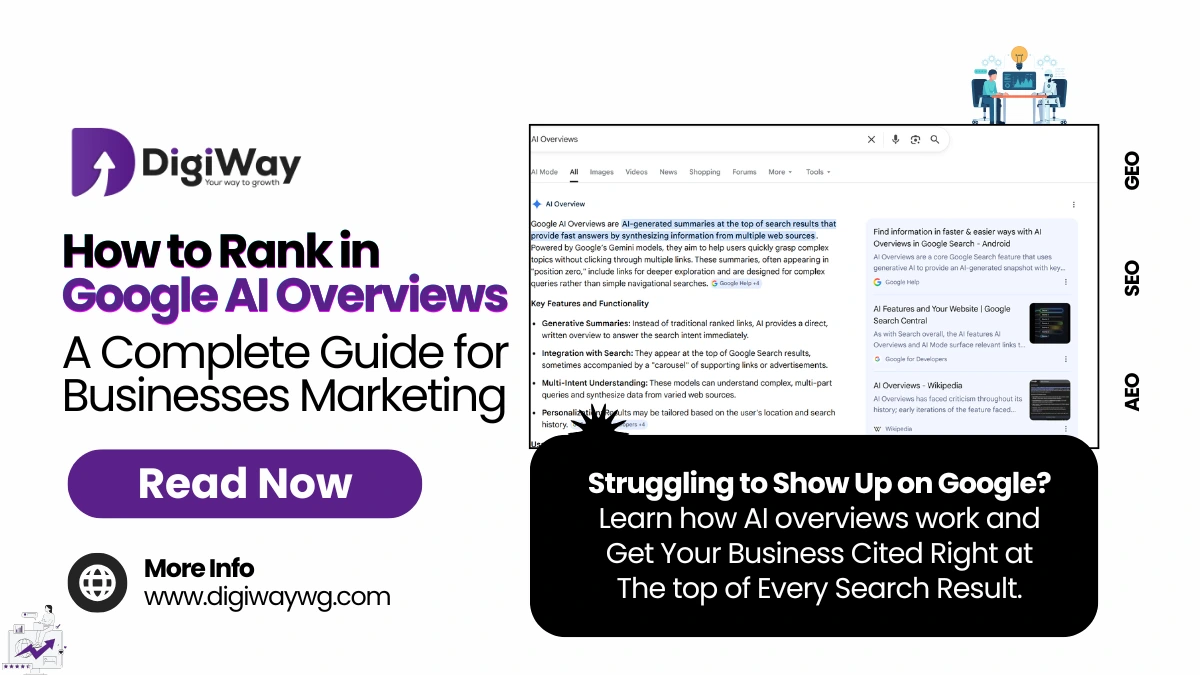
Is Your Business Showing Up Where It Matters Most?
Open Google right now and search for anything — “best digital marketing tips” or “how to grow my business online.” Before you see a single link, Google has already given you a full answer at the top of the page. That is Google AI Overviews at work.
In 2026, AI Overviews appear on billions of searches every month. They sit at the very top of Google’s results page, summarising information from multiple sources into a single, concise answer. If your brand is cited in that summary, you win. If you’re not, you’re invisible, no matter how well you rank below it.
The good news? Any business, big or small, can earn a spot in Google AI Overviews. You do not need a massive budget or a huge website. You need the right strategy.
What Are Google AI Overviews?
Google AI Overviews are short, AI-written summaries that appear at the very top of Google search results. Google’s AI reads multiple web pages and pulls the most useful information together into one clear answer.
They show up most often when someone asks a question — like “how to improve website ranking” or “what is content marketing.” Google does not just link to one page. It reads several and writes a combined answer, giving credit to the sources it used.
Here is what that means for your business: if Google’s AI uses your content as a source, your website gets featured. People see your brand at the top, even if you are not ranked number one in the traditional results.
Key fact: AI Overviews now appear on millions of searches every day. When they appear, the click-through rate on links below them drops by up to 42%. Being inside the overview — not below it — is where the real visibility is.
Why This Matters for Your Business
A few years ago, ranking on the first page of Google was enough. Then ranking in the top three mattered more. Now, the game has changed again. AI Overviews appear above all organic results, even above position one.
When a user sees a clear, well-written answer right at the top of the page, they trust it. They may not click any links at all. So if your website is the source Google’s AI used to write that answer, you get the brand recognition without even needing the click.
This is especially valuable for businesses trying to build authority in their industry. When Google cites you, people see you as an expert, and that trust leads to more enquiries, more website visits, and more conversions.
5 Practical Ways to Get Featured in Google AI Overviews
Getting into AI Overviews is not about tricking Google. It is about creating content that is genuinely helpful and easy for AI to read, understand, and use. Here are five strategies that work.
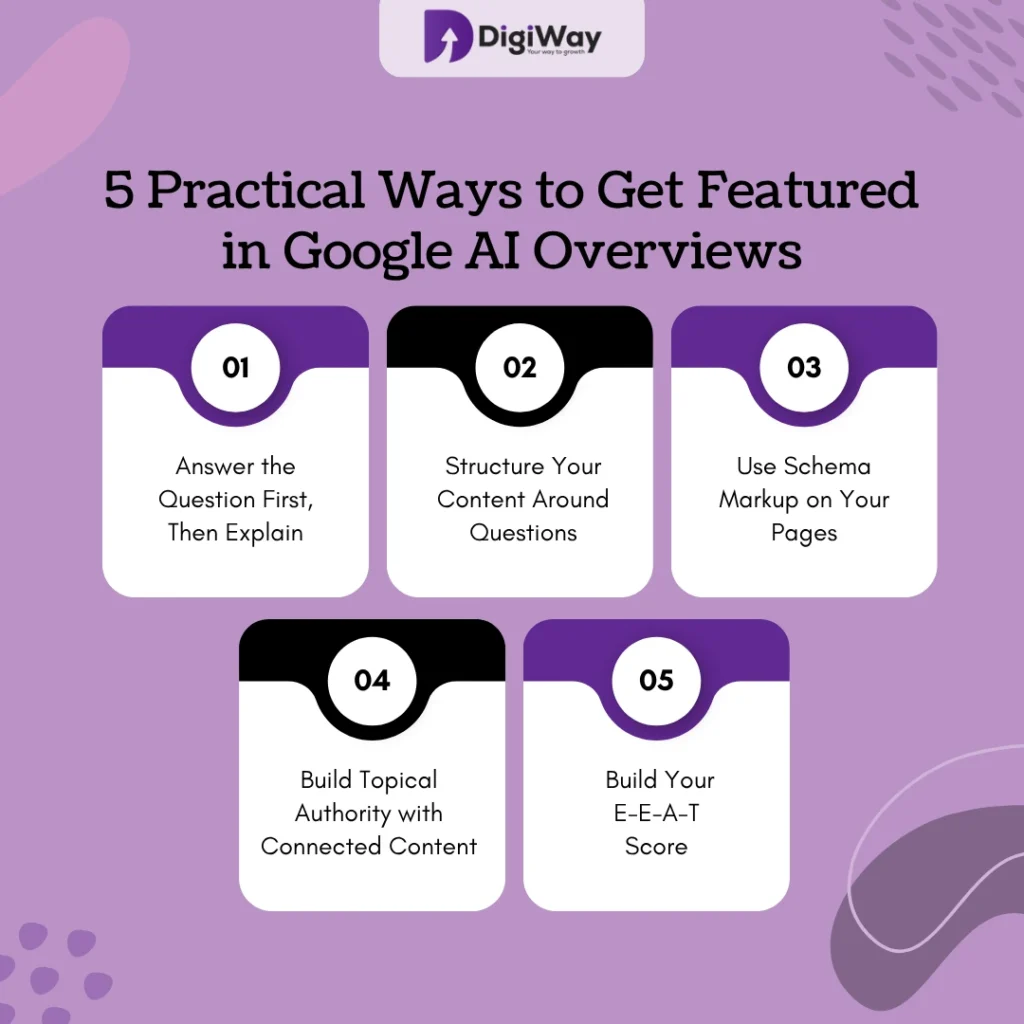
- Answer the Question First, Then Explain
Most writers build up to their answer. AI prefers the opposite. Start each section with a clear, direct answer in the first one or two sentences. Then add context, examples, and detail below it.
For example, if your heading is “What is topical authority?”, your opening sentence should directly define it rather than introduce it. This “answer-first” approach is what makes content easy for Google’s AI to extract and cite.
- Structure Your Content Around Questions
Google AI Overviews are triggered mostly by question-based searches. So write your headings as questions too. Use formats like “How does X work?”, “What is the best way to Y?”, and “Why does Z matter?”
Under each question, write a short, focused answer of 40 to 60 words. This is a core principle of AEO — Answer Engine Optimisation, and it is one of the fastest ways to improve your chances of being cited.
- Use Schema Markup on Your Pages
Schema markup is a small piece of code you add to your website that helps Google understand what your content is about. Think of it as a label that tells Google’s AI: “This section is an FAQ” or “This is a how-to guide.”
The most useful schema types for AI Overview visibility are FAQ Schema, HowTo Schema, and Article Schema. Most SEO plugins like Rank Math or Yoast make it easy to add these without any coding knowledge.
- Build Topical Authority with Connected Content
Google’s AI does not just judge one page. It reviews your entire website to determine whether you are a trusted source on a given subject. If you only have one blog on SEO, that is not enough. But if you have 10 well-written, interconnected blog posts covering different aspects of SEO, Google sees you as an authority.
This is called a content cluster. Write a main “pillar” page on your core topic, then write supporting blogs that link back to it. This structure tells Google’s AI that your website covers a subject deeply, and deeply covered topics get cited more often.
- Build Your E-E-A-T Score
E-E-A-T stands for Experience, Expertise, Authoritativeness, and Trustworthiness. It is Google’s way of measuring whether a source is worth citing. Here is how to improve yours:
- Add author bios that show real experience and qualifications.
- Share case studies, results, and original insights from your own work.
- Get mentions and backlinks from respected websites in your industry.
- Update your content regularly so it stays accurate and current.
- Display reviews, testimonials, and trust signals on your website.
The stronger your E-E-A-T, the more Google trusts your content, and the more likely it is to use it in AI-generated summaries.
GEO: Optimising Beyond Just Google
Google AI Overviews are just one piece of the puzzle. People are now also using ChatGPT, Perplexity, and Google Gemini to find answers, and these platforms also pull information from websites just like Google does.
GEO — Generative Engine Optimisation — is the practice of making your content visible and citable across all AI-powered search platforms, not just Google. The good news is that what works for Google AI Overviews also works for ChatGPT and Perplexity: clear structure, direct answers, factual content, and strong authority signals.
For businesses in India and around the world, this is a huge opportunity. Most competitors have not yet optimised for AI-driven search. Getting in early gives your brand a real advantage that compounds over time.
Common Mistakes That Are Keeping You Out
Many businesses have good content, but still do not appear in AI Overviews. Here are the most common reasons why:
- Vague headings: Generic headings like “Our Services” give AI no useful signal. Use specific, question-based headings instead.
- No FAQ sections: If you do not have structured Q&A blocks with schema, you are missing one of the easiest paths into AI Overviews.
- Thin content: Short, shallow blogs do not provide enough depth for AI to trust and cite. Aim for thorough, useful content that fully covers the topic.
- No internal links: Without linking related pages together, Google cannot map your topical authority. Always link to relevant blogs and service pages.
- Slow website: Core Web Vitals are a trust signal. A slow, hard-to-use website signals poor quality — and AI avoids citing poor-quality sources.
Frequently Asked Questions
Q1. How do I get my website featured in AI Overviews?
Ans: Create clear, helpful content with direct answers, question-based headings, FAQ schema, and strong E-E-A-T signals.
Q2. Do AI Overviews reduce website traffic?
Ans: They may lower clicks for some sites, but websites cited in AI Overviews often gain better visibility and higher-quality traffic.
Q3. What is the difference between SEO, AEO, and GEO?
Ans: SEO improves traditional rankings. AEO helps content appear in direct answers. GEO optimizes visibility across AI platforms like OpenAI ChatGPT and Google AI search.
Q4. Can a small business rank in Google AI Overviews?
Ans: Yes. Small businesses with niche, useful, and well-structured content can rank in Google AI Overviews.
Q5. How to rank for Google AI Overviews?
Ans: Use answer-first content, strong SEO, FAQs, schema markup, and build authority through consistent publishing.
Q6. How do I rank my business at the top of Google?
Ans: Improve on-page SEO, create quality content, earn backlinks, optimize your Google Business Profile, and speed up your website.
Q7. What are the 4 pillars of SEO?
Ans: The four pillars are Technical SEO, Content, On-Page Optimization, and Off-Page Authority.
Conclusion: Start Optimising for AI Search Today
Google AI Overviews are not going away. They are becoming more powerful and more widely used every month. Businesses that adapt their content strategy now will build a lasting advantage — not just on Google, but across every AI-powered search platform.
The steps are straightforward: write helpful, answer-first content. Use question-based headings. Add schema markup. Build content clusters. Strengthen your E-E-A-T. And keep your website fast and user-friendly.
You do not need to do everything at once. Start with one blog, apply these principles, and build from there. The brands that are consistent today will be the ones dominating AI search tomorrow.
Want to get your brand into Google AI Overviews?
At Digiway, we help businesses across India and globally build SEO, AEO, and GEO strategies that drive real growth. From content creation to technical optimisation — we know exactly what it takes to get your brand cited by AI and chosen by customers.
Get Your Free Consultation Today!